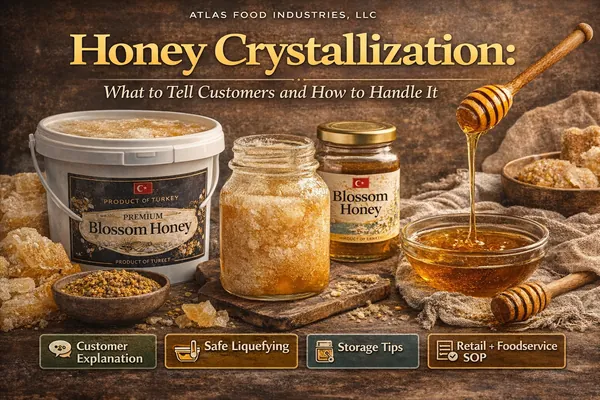
If you sell or serve honey long enough, you will see it: a once-clear jar becomes opaque, grainy, or solid. Customers often ask whether it “went bad,” whether sugar was added, or whether the product is old. In reality, crystallization is a normal and expected behavior of genuine honey, driven by its natural sugar composition.
1) What is honey crystallization?
Honey is a supersaturated sugar solution—meaning it contains more dissolved sugars than water can normally hold. Over time, some of the sugars (especially glucose) come out of solution and form tiny crystals. As crystals grow and link together, honey becomes thicker, cloudy, and eventually semi-solid or fully set.
This is not fermentation and not spoilage. Crystallization is a physical change in texture, not a safety failure. The flavor may even feel more “rounded” because aroma compounds release differently in a thicker matrix.
2) Why does honey crystallize faster in some cases?
Crystallization speed varies by batch. The most important drivers are:
- Glucose-to-fructose ratio: higher glucose content typically crystallizes faster.
- Natural “seed” particles: pollen and fine particles can act as crystal starting points.
- Temperature: cool storage (including refrigeration) commonly accelerates crystallization.
- Moisture level: lower water content can crystallize more readily; higher moisture raises fermentation risk (a separate issue).
- Time + handling: vibration, frequent temperature swings, and repeated opening can change crystallization behavior.
3) What to tell customers: scripts your team can use
Customers usually want reassurance and a simple instruction. Train staff with short, consistent statements:
- “Is it spoiled?” “No—crystallization is natural. The honey is still safe and usable.”
- “Did you add sugar?” “No—real honey can crystallize because of its natural glucose content.”
- “Can I fix it?” “Yes—place the closed jar in warm water and stir occasionally until it softens.”
- “Should I refrigerate honey?” “Usually no—refrigeration can make it crystallize faster. A cool, dry cupboard is best.”
4) How to liquefy crystallized honey safely (retail + foodservice)
The goal is to restore flow without burning aromas or pushing temperatures too high—especially if you position honey as premium or “raw-style.” A gentle approach protects taste and consumer trust.
Warm water bath method (recommended)
- Keep the lid closed (to prevent water ingress).
- Place the container in a bowl or sink of warm water. Avoid boiling water.
- Refresh the water as it cools. Stir or rotate the container periodically.
- Stop once the honey loosens to your preferred consistency.
Common mistakes to avoid
- Microwaving in plastic: uneven hot spots can degrade aroma and risk container deformation.
- Direct flame / hot plate contact: scorching at the bottom creates burnt notes and darkening.
- Overheating repeatedly: repeated high heat cycles can reduce sensory quality over time.
- Warming with the lid open: moisture can enter, increasing fermentation risk in higher-moisture honeys.
5) Storage guidance: how to reduce crystallization complaints
You cannot “prevent” crystallization permanently in authentic honey, but you can reduce fast onset and improve customer experience:
- Keep it sealed: honey is hygroscopic and can absorb moisture from air over time.
- Stable temperatures: avoid repeated hot/cold cycling (near windows, heaters, or walk-in doorways).
- Do not refrigerate: cold storage often speeds crystallization for many honey types.
- Merchandising tip: in retail, keep honey away from refrigerated endcaps and cold air vents.
6) Retail SOP: handling crystallized jars on shelf
A crystallized jar is not a “damaged” jar. For premium positioning, treat crystallization as a natural quality feature and manage presentation.
| Shelf situation | Likely cause | Recommended action |
|---|---|---|
| Jar is cloudy and thick but still pourable | Early-stage crystallization | Keep on shelf. Consider a small shelf talker: “Natural crystallization may occur.” |
| Jar is fully set / firm | Advanced crystallization, cool storage | Keep on shelf if packaging is intact. Offer customer guidance on warm-water bath to liquefy. |
| Layering: liquid on top, crystals below | Normal crystallization pattern | Reassure customers. Texture variation is normal; warm gently if uniform texture is desired. |
| Foam, gas, or sour smell | Possible fermentation (separate from crystallization) | Remove from shelf and follow QA procedure. Review storage conditions and batch moisture controls. |
7) Foodservice SOP: squeeze bottles, portion cups, and back-of-house
Foodservice teams care about flow, portion control, and speed. If honey crystallizes in squeeze bottles, service slows down and staff may overheat honey trying to fix it quickly. Use a simple SOP:
- Standardize storage: keep honey in a dry ambient area (not in the walk-in).
- Set a safe warming option: warm-water bath or low-temp holding cabinet for short periods.
- Rotate bottles: refill and rotate to minimize long sits at inconsistent temperatures.
- Label and date: basic rotation controls preserve flavor integrity.
8) Buyer and importer notes: reduce returns and improve clarity
In B2B channels, crystallization complaints often come down to expectation-setting. You can reduce friction by aligning on:
- Label language: add a simple line such as “Natural crystallization may occur.”
- Pack format selection: glass jars vs. squeeze bottles vs. bulk; each behaves differently in customer hands.
- Temperature profile in transit: winter shipments and cold warehouses accelerate crystallization on arrival.
- Product positioning: premium/origin honeys can embrace crystallization; industrial applications may prefer standardized flow.
9) One-minute quick guide (for your team board)
- Crystallization = natural texture change. Not spoilage, not “added sugar.”
- Warm water bath. Gentle warming restores flow; avoid boiling and direct heat.
- No fridge. Refrigeration often speeds crystallization.
- Communicate clearly. A single shelf note prevents most returns.
10) FAQ (customer-friendly)
Is crystallized honey safe? Yes. Crystallization is normal and does not make honey unsafe.
Does crystallization mean it is raw? Not necessarily. Many real honeys crystallize; processing and filtration can influence how quickly.
How long does it take to crystallize? It depends on floral source, storage temperature, and batch composition. Some honeys crystallize in weeks; others take months.
Can I eat it crystallized? Absolutely—many consumers enjoy it as a spread on toast or as a textured topping.