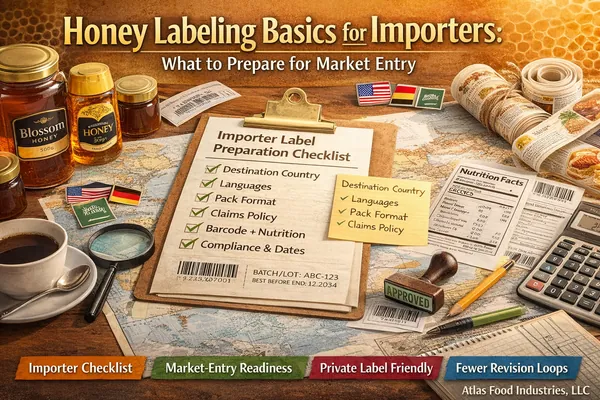
For import programs, the label is often the slowest part of market entry—not because honey is complex, but because each destination market has its own mandatory fields, language rules, and claim restrictions. A short, structured preparation step reduces redesign cycles and accelerates quotation, artwork approval, and shipment planning.
1) Buyer inputs to prepare before label design
Importers can save substantial time by preparing a small “label input pack” before requesting artwork. This clarifies what must appear on pack and what must be avoided in your target market.
| Input | What to decide | Why it matters |
|---|---|---|
| Destination country | Country + any regional rules (if applicable) | Determines mandatory fields and language requirements |
| Channel | Retail / foodservice / ingredient | Drives pack format and information hierarchy |
| Pack format | Jar / squeeze / portion cups + net weight(s) | Impacts label size, space, and required presentation |
| Languages | Primary + secondary languages | Prevents late-stage layout rework |
| Importer identity | Legal name, address, contact, registrations (as needed) | Often required for market entry and traceability |
| Brand architecture | Brand name, sub-brand, SKU naming conventions | Ensures consistent portfolio and shelf navigation |
| Claims policy | Which claims are allowed/avoided for your market | Reduces compliance risk and relabeling cost |
2) Core label elements to plan (high-level)
While specifics vary by country, most honey labels generally revolve around a core set of information blocks. Planning these early helps you allocate space and avoid last-minute “no room on the label” problems.
Typical information blocks
- Front-of-pack identity: product name and variant (e.g., blossom, pine, monofloral)
- Net quantity: clear and compliant presentation
- Origin statement: country of origin and/or origin narrative as permitted
- Responsible operator: importer/distributor details as required
- Traceability: lot/batch identification and date coding approach
- Storage guidance: practical handling notes (market-dependent)
- Barcode: EAN/UPC per your market and retailer requirements
3) Product naming and positioning: keep it consistent
Importers often underestimate how much time is lost debating SKU naming mid-design. Decide early whether your market prefers “Blossom Honey,” “Flower Honey,” “Pine Honey,” or a region-forward naming approach, and keep it consistent across the portfolio.
4) Artwork workflow: what to request from your supplier
To reduce back-and-forth, treat label creation as a workflow with defined inputs and outputs. A supplier can move faster when they know your file expectations and approval steps.
A practical sequence
- Confirm destination country + channel + packaging format(s)
- Define SKU naming and claims policy
- Draft label text blocks (content first, design second)
- Apply to dieline, review legibility and hierarchy
- Internal compliance check (or local partner review)
- Finalize print-ready files and coding positions
5) Claims and “avoid list”: prevent compliance risk
Claims are a common source of regulatory and retailer rejection. Even if you want a “premium” message, keep the label compliant and use brand storytelling where permitted. Establish an “avoid list” for your market so the designer does not unintentionally add problematic language.
6) Copy/paste: importer label input pack
Channel (retail/foodservice/ingredient):
Packaging format(s) + net weight(s):
Label language(s):
SKU name style (blossom/pine/monofloral/origin-forward):
Brand name + SKU naming convention:
Importer/distributor legal details (name, address, contact):
Barcode format (EAN/UPC) + who provides codes:
Claims policy: allowed claims / avoid list:
Artwork outputs needed (PDF print-ready, editable file, dieline):
Coding/traceability preference (lot/date placement):
If you would like a tailored recommendation, send your destination country, packaging preference, and approximate volume. We will respond with a practical next step and suggested product family list.