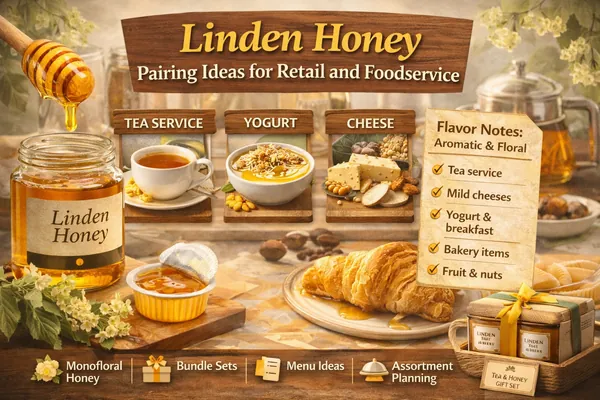
Linden honey earns its place in premium assortments when buyers give customers a clear “use case.” The fastest way to sell monofloral honey is to connect it to familiar rituals: tea, breakfast, cheese boards, yogurt, pastry, and simple drizzles. The goal is not to over-explain—just to provide a few strong pairing cues that make the product easy to choose.
A simple “what it’s for” pairing cue improves conversion.
Monofloral + aroma story supports higher shelf pricing.
Everyday uses (tea, yogurt) drive replenishment.
Contents
1) Flavor profile and how to describe it 2) Retail pairing ideas and bundles 3) Foodservice menu applications 4) Assortment plan: where linden fits 5) Merchandising and sampling tips 6) RFQ checklist for linden honey 7) FAQ1) Flavor profile and how to describe it
Buyers typically position linden honey as aromatic and floral with a clean finish. Keep the description practical and customer-facing:
- Short label line: “Aromatic floral honey for tea, yogurt, and cheese.”
- Shelf talker line: “Premium monofloral—great for tea service and breakfast drizzles.”
- Menu line: “Linden honey drizzle (aromatic floral).”
2) Retail pairing ideas and bundles
In retail, linden honey performs best when it is merchandised near products it upgrades. The objective is to make the add-on decision obvious.
High-conversion pairings (retail)
- Tea and herbal infusions: “Sweeten naturally” cue for tea drinkers.
- Breakfast set: yogurt + granola + linden honey (simple “drizzle” instruction).
- Cheese board: mild cheeses + nuts + honey (premium entertaining occasion).
- Bakery: croissant / brioche / toast + linden honey (classic breakfast add-on).
- Fruit and nuts: figs, apples, walnuts, almonds (snacking cue).
Bundle formats that support premium pricing
| Bundle idea | Why it sells | Where to place |
|---|---|---|
| Tea + honey duo | Simple ritual; strong repeat purchase | Tea aisle / endcap |
| Breakfast trio (yogurt/granola/honey) | Clear use; “drizzle” instruction | Dairy or breakfast fixture |
| Cheese board kit (honey + nuts + crackers) | Occasion-based; premium gifting | Deli / specialty |
| Monofloral tasting set (2–3 honeys) | Sampling supports trade-up | Premium honey shelf |
3) Foodservice menu applications
In foodservice, linden honey is best treated as a finishing drizzle or a light sweetener that adds aroma. Keep applications operationally simple.
Fast, repeatable applications
- Tea service: linden honey as the default honey option (premium cue).
- Breakfast bowls: yogurt bowl drizzle; granola bowl drizzle.
- Bakery plating: honey drizzle on toast/pastry with butter or soft cheese.
- Cheese plate: small ramekin side; “pair with mild cheese” note.
- Dressings and glazes: use when you want aroma more than heavy sweetness.
4) Assortment plan: where linden fits
Linden typically performs as a premium tier item inside a simple honey ladder:
| Tier | Role | Examples |
|---|---|---|
| Core | Volume, everyday value | Blossom / multifloral |
| Premium | Trade-up with a clear story | Linden (monofloral), regional lines |
| Signature | Hero SKU / gifting | Limited origin, specialty presentations |
5) Merchandising and sampling tips
- Use one pairing cue per shelf tag: “For tea,” “For yogurt,” or “For cheese.”
- Sampling strategy: pair with a neutral carrier (plain yogurt or mild cheese) to highlight aroma.
- Premium display: place near other monoflorals with consistent label design to look “collectible.”
- Gift positioning: “tea + honey” or “cheese board” themes move premium jars.
6) RFQ checklist for linden honey
- Destination country: ________
- Channel: retail / foodservice / ingredient
- Packaging format: glass jar / squeeze / portion cups / bulk
- Target net weight(s): ________
- Label language(s): ________
- Order quantity range: ________
- Assortment plan: linden only / with blossom / with other monoflorals
- Documentation needs: spec sheet, batch/lot info, destination requirements
7) FAQ
What does linden (tilia) honey taste like?
Linden honey is typically aromatic and floral with a clean finish. Because it is monofloral, buyers often position it as a premium, origin-led honey with a distinctive profile compared with everyday blossom honey.
What are the best pairings for linden honey?
Strong pairing anchors include tea service, mild cheeses, yogurt and breakfast bowls, pastry/toast, and fruit/nut combinations. In foodservice, it works well as a finishing drizzle or in light dressings/glazes when aroma is the goal.
How do retailers merchandise linden honey in premium assortments?
Retailers commonly place it with other monoflorals/regional honeys, provide one clear serving cue (“for tea” / “for yogurt”), and use tasting sets or small bundles (tea + honey, cheese board kit) to support premium price positioning.