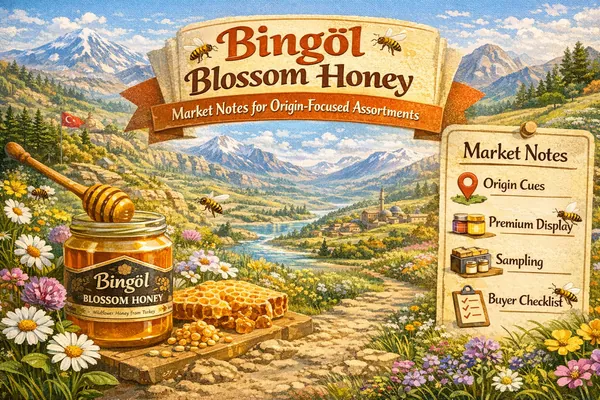
Origin-focused shoppers do not buy premium honey only for sweetness—they buy for identity, trust, and a sense of curation. Bingöl blossom honey is well suited to this segment because it can be positioned as a premium regional blossom option within a portfolio that also includes a core everyday honey and a contrasting profile (commonly pine).
Translate “origin” into shelf-ready messaging.
Use sampling to remove premium hesitation.
Reduce reorder friction with buyer-friendly info.
Contents
1) How origin-focused shoppers evaluate regional honey 2) What to communicate for Bingöl blossom honey (without overclaiming) 3) Sensory positioning: ranges beat absolutes 4) Packaging formats that sell premium regional honey 5) Sampling programs that convert premium buyers 6) Assortment design: where Bingöl fits in the ladder 7) Buyer checklist for RFQ and launch 8) FAQ1) How origin-focused shoppers evaluate regional honey
Origin-driven buyers often make decisions quickly. They want signals that feel specific and trustworthy—then they trade up. In practice, these shoppers tend to evaluate premium regional honey through five lenses:
- Clarity of origin: Is the region name prominent and readable?
- Story simplicity: Can they repeat the story in one sentence?
- Trust cues: Batch/lot code, professional label layout, and consistent naming across the line.
- Usage confidence: How should it be used (breakfast, yogurt, tea, gifting)?
- Portfolio logic: Does it sit above a core honey and alongside a contrasting profile?
2) What to communicate for Bingöl blossom honey (without overclaiming)
For regional honey, the goal is to make “origin” concrete without making claims you cannot support consistently. A reliable structure is: Place → Style → Sensory direction → Occasion.
Label / shelf-talker message (template)
- Origin: “Bingöl, Turkey” (keep it prominent)
- Style: “Blossom honey” (sets correct expectations)
- Notes: “Balanced floral sweetness with a clean finish” (range-based)
- Use: “Breakfast, yogurt, tea, gifting” (4 quick cues)
3) Sensory positioning: ranges beat absolutes
Honey varies naturally by season and batch. Premium brands earn trust by describing a likely range instead of a rigid promise.
| Attribute | Preferred language | Avoid |
|---|---|---|
| Color | Light-to-medium amber (range) | Exact color promises |
| Aroma | Floral-forward, gentle herbal hints | Overly technical terms |
| Finish | Clean, smooth, lightly lingering | “Always” / “never” statements |
| Texture | Smooth; crystallization may occur naturally | “Will not crystallize” claims |
4) Packaging formats that sell premium regional honey
For origin-focused shoppers, packaging is part of the value proposition. The formats below typically support premium conversion:
- Glass jars: premium shelf presence and gifting readiness.
- Mini jars: trial conversion, bundling, and sampler sets.
- Gift boxes / sleeves: seasonal peaks and premium display.
Premium cues buyers notice immediately
- Consistent naming across the regional series (e.g., “Bingöl Blossom Honey”)
- Short origin note (one paragraph max) + usage cues
- Visible lot/batch coding for traceability confidence
- Clean label layout (avoid clutter and excessive claims)
5) Sampling programs that convert premium buyers
Sampling works because it removes uncertainty without discounting the product. For regional assortments, the most reliable programs are:
- Regional trio: 2 regional blossoms + 1 pine honey for contrast.
- Discovery minis: 3–4 minis with a simple “tasting path” (mild → bold).
- Bundle add-on: add a mini Bingöl jar to a core honey order.
- Gifting sampler: boxed minis for corporate and seasonal campaigns.
6) Assortment design: where Bingöl fits in the ladder
Bingöl blossom honey is best positioned as a premium regional blossom tier above your everyday honey SKU. It performs well when the shopper can see the ladder:
| Tier | SKU example | Role |
|---|---|---|
| Core | Everyday blossom honey | Volume and repeat purchase |
| Contrast | Pine honey | Category expansion and differentiation |
| Premium origin | Bingöl Blossom Honey | Trade-up, gifting, premium margin |
| Add-on | Mini sampler / bee products | Basket expansion |
7) Buyer checklist for RFQ and launch
RFQ inputs that reduce back-and-forth
- Destination country + channel (specialty retail, mainstream retail, e-commerce, gifting)
- Preferred packaging (glass jar / minis / gift set) and labeling language needs
- Target volumes (trial order + 2nd order forecast)
- Any internal QA requirements (spec sheet, batch coding, compliance program needs)
Launch plan (simple, effective)
- Choose 2–3 usage occasions you will repeat consistently in marketing
- Pick one sampling program (trio pack or minis) before inventory lands
- Prepare shelf talkers / product page assets (origin note + tasting range + usage cues)
- Merchandise as premium (above core honey; cross-merch with tea/yogurt/gifting)
8) FAQ
What do origin-focused shoppers look for on a regional honey label?
Clear origin naming, a simple story they can repeat, batch/lot coding for confidence, and practical usage cues. Short origin notes outperform long paragraphs.
How should Bingöl blossom honey be positioned in an assortment?
Place it as a premium regional blossom option above an everyday honey SKU. Pair it with a contrasting profile such as pine honey, and consider a mini-jar sampler to convert premium buyers.
What formats work best for premium regional honey?
Glass jars and mini jars typically perform best for premium positioning because they are giftable, photograph well, and support origin storytelling via labels or inserts.
How should premium brands address crystallization?
Treat crystallization as a normal honey characteristic. A short storage note and simple guidance helps reduce returns and builds trust.