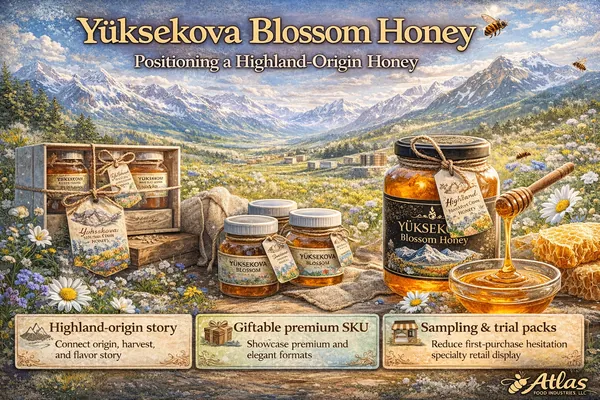
Regional honey is not just a flavor SKU; it is a storytelling SKU. When you present a highland-origin honey such as Yüksekova blossom honey, your commercial objective is usually to achieve one (or more) of the following: trade customers up to a premium jar, build gifting behavior, increase basket size, or support a specialty assortment with an origin-forward product that feels distinct from a “standard blossom honey.”
This article provides buyer-ready guidance on how to position a highland-origin honey in retail and e-commerce, how to choose packaging formats that sell the story, and which documentation points reduce friction for repeat orders. The goal is simple: make the first shipment successful and the second shipment routine.
Translate “origin” into value without overclaiming.
Use sampling formats to reduce first-purchase hesitation.
Batch consistency + documentation supports reorder confidence.
Contents
1) What “highland-origin” means in buyer language 2) The 4 positioning pillars that sell premium origin honey 3) Sensory expectations: how to describe without overclaiming 4) Packaging formats that enable gifting, sampling, and premium display 5) Merchandising and display tactics for specialty retail 6) E-commerce: bundles, subscriptions, and conversion tools 7) Price architecture and assortment planning 8) Documentation and batch information buyers request 9) Buyer checklist for RFQ and launch 10) FAQ1) What “highland-origin” means in buyer language
“Highland-origin” can be meaningful, but only if the story is translated into a buyer-safe and customer-friendly message. In commercial terms, the value of a highland-origin honey is typically communicated through:
- Regional identity: a clearly named area that consumers can remember and repeat.
- Small-batch perception: even when volumes are professional, origin SKUs feel curated.
- Seasonal narrative: harvest timing supports a “limited” feel and encourages early purchasing.
- Giftability: origin and place storytelling supports premium packaging and higher willingness to pay.
2) The 4 positioning pillars that sell premium origin honey
Premium origin honeys typically succeed when positioning is built on a small number of consistent pillars. These pillars should appear across your label, product page, shelf talker, and sales script.
| Pillar | What it communicates | Where to use it | Example buyer-safe angle |
|---|---|---|---|
| Origin | Place, sourcing, identity | Front label, product page headline | “Regional blossom honey sourced from the Yüksekova area.” |
| Sensory | Taste, aroma, color, texture | Back label, tasting notes, merchandising | “Balanced sweetness with floral notes; smooth mouthfeel.” |
| Occasion | How it is used | Recipes, bundles, shelf tags | “Breakfast pairing, yogurt drizzle, gifting.” |
| Proof | Professionalism and repeatability | B2B pages, procurement decks | “Batch coding + specification documents available on request.” |
3) Sensory expectations: how to describe without overclaiming
Honey is naturally variable. For origin products, buyers should avoid promising a fixed flavor profile. Instead, describe consistent boundaries—the style and typical direction—while acknowledging seasonal variation.
A practical sensory description framework
- Base style: blossom honey (not pine/honeydew), origin-forward.
- Flavor direction: floral-forward, balanced sweetness, medium intensity.
- Color range: describe as “light to medium amber” or similar range-based language.
- Texture: smooth; crystallization can occur naturally depending on season and storage.
4) Packaging formats that enable gifting, sampling, and premium display
Format is strategy. Premium origin honey benefits from formats that look giftable, photograph well for e-commerce, and support “trial” behavior for new customers.
Recommended SKU architecture (buyer-friendly)
| SKU type | Purpose | Format ideas | Best channels |
|---|---|---|---|
| Hero jar | Premium anchor item | Glass jar + premium label | Specialty retail, gifting, e-commerce |
| Sampler | Trial conversion | Mini jars, trio packs | E-commerce, boutique retail, events |
| Gift set | Seasonal and corporate gifting | Boxed set with story card | Corporate, premium retail, holidays |
| Foodservice format | Brand exposure | Portion cups or table squeeze (channel-dependent) | Hotels, cafés, curated breakfast venues |
Label and pack details that signal premium
- Clear origin statement: short, readable, consistent across all assets.
- Batch/lot coding: visible and legible for QA and traceability.
- Story card or neck tag: explains usage and why the origin matters.
- Photography: plan the pack to look premium under natural light for online listings.
5) Merchandising and display tactics for specialty retail
Premium origin honeys sell when customers can quickly answer two questions: “Why is this special?” and “How will I use it?” Display should do this work in seconds.
High-performing retail tactics
- Tiered shelving: place origin honey above core everyday honey to signal trade-up.
- Shelf talker: 1 line for origin, 1 line for taste, 1 line for best use.
- Cross-merchandising: place near tea, yogurt, cheese, or gifting sections.
- Sampling plan: small tastings (where permitted) or micro-jar sampling kits.
6) E-commerce: bundles, subscriptions, and conversion tools
Online, your biggest enemy is uncertainty. Origin honey is unfamiliar to many buyers, so your product page must reduce questions while reinforcing premium value.
What to include on the product page
- Short story: origin and harvest framing in 3–5 lines.
- Tasting notes: range-based, honest, and readable.
- Usage ideas: 4–6 quick serving suggestions (breakfast, yogurt, cheese board, tea).
- Storage guidance: simple, non-alarming instructions.
- Trust signals: batch coding, supplier info, documentation availability (B2B pages).
Bundle strategies that work
- Origin trio: Yüksekova + one additional regional blossom + pine honey for contrast.
- Breakfast bundle: honey + tahini + tea (or similar culturally aligned set).
- Gift set: premium jar + story card + optional spoon or small accessory.
7) Price architecture and assortment planning
Premium origin honey should not be your only honey. Most buyers succeed with a portfolio approach: a core everyday SKU drives volume and repeat, while the origin SKU creates margin and differentiation.
Portfolio logic (simple and effective)
- Core SKU: daily-use blossom honey (volume driver).
- Differentiator: pine honey or specialty style (contrast).
- Premium origin: Yüksekova blossom honey (story + gifting).
- Add-on: bee pollen, propolis blends, or mini set (basket expansion).
8) Documentation and batch information buyers request
Premium positioning improves when the supply side looks professional. Buyers commonly request documentation and batch-linked information to support compliance, internal QA, and repeatability across shipments.
- Specification sheet: product definition, typical sensory range, storage conditions.
- Batch/lot identification: lot code format, production/packing date references.
- Label text alignment: buyer-safe product description consistent with destination rules.
- Export documentation: commercial invoice, packing list, and destination-required items.
- Optional certificates: depending on market and buyer compliance programs.
9) Buyer checklist for RFQ and launch
Before requesting a quotation
- Destination country and intended channel (specialty retail, mainstream retail, e-commerce, gifting)
- Preferred packaging format (glass jar, sampler packs, gift sets)
- Target order size and reorder cadence
- Label language requirements and any mandatory markings
For launch planning
- Define 2–3 usage occasions you will market consistently (breakfast, gifting, pairing)
- Decide sampling strategy (mini jars, trio packs, in-store tastings where permitted)
- Prepare product page assets (photos, short origin story, tasting notes, storage guidance)
- Plan a portfolio: core SKU + differentiator + premium origin
10) FAQ
How should a buyer describe Yüksekova-origin blossom honey without overclaiming?
Use buyer-safe language focused on origin, sensory expectations, and usage occasions. Avoid medical claims. Emphasize harvest season, regional sourcing, and consistent batch documentation.
Which packaging formats work best for premium origin honeys?
Premium origin honeys typically perform well in glass jars for retail and gifting, plus smaller sample sizes for trial and bundle strategies. Format choice should match channel needs, shelf presentation, and your reorder cadence.
What should importers request to support premium positioning?
Importers often request a specification sheet, batch/lot identification, and a clear product description aligned to labeling rules. Some buyers also request additional certificates depending on destination and customer requirements.
How should buyers handle crystallization in premium honey?
Crystallization can be a natural property of honey. Premium brands often treat it as an education opportunity: explain that gentle warming can return honey to a smoother texture and that storage practices influence crystallization speed.