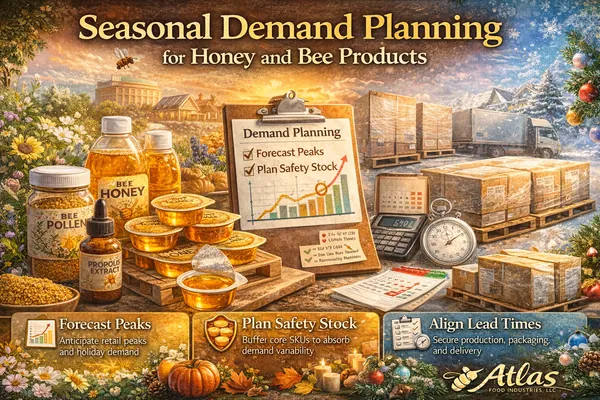
Seasonal demand planning is where honey procurement becomes a supply-chain problem, not just a sourcing decision. Demand can spike around promotions, colder weather, holiday baking, or hospitality high seasons. Buyers who plan early maintain service levels and stable pricing; buyers who plan late often face short fills, expedited logistics, packaging bottlenecks, and inconsistent availability across SKUs.
Avoid stockouts during peaks and promotions.
Reduce emergency freight and last-minute changes.
Better packaging readiness and smoother replenishment.
Contents
1) What drives seasonality in honey and bee products 2) The planning horizon: when to start and what to lock 3) A simple forecasting framework buyers can execute 4) Safety stock and buffer strategy 5) Lead times: product vs packaging vs documentation 6) Managing promotions without creating stockouts 7) Portfolio planning: core SKUs vs seasonal SKUs 8) How to brief suppliers for seasonal execution 9) A buyer-ready seasonal planning checklist 10) FAQ1) What drives seasonality in honey and bee products
Seasonality is not one universal curve. It differs by channel and product family. A retail honey SKU may peak during holiday baking, while foodservice demand may track tourism and occupancy. Bee products can follow wellness trends and promotional calendars.
- Retail seasonality: gifting, baking seasons, and promotional circulars.
- Foodservice seasonality: tourism peaks, conference seasons, and menu rotations.
- Hospitality seasonality: occupancy patterns and breakfast cover counts.
- Wellness seasonality: “immune season” demand for propolis and functional blends.
- Promotional seasonality: campaigns that temporarily multiply baseline volume.
2) The planning horizon: when to start and what to lock
A practical planning horizon for most buyers is 8–16 weeks before the peak. This window allows time to confirm volume assumptions, secure packaging, align labeling, and account for transport realities.
| Time before peak | What buyers should do | Why it matters |
|---|---|---|
| 12–16 weeks | Validate forecast, confirm SKUs, align packaging and labels, book production slot | Prevents packaging bottlenecks and rush changes |
| 8–12 weeks | Lock purchase orders for peak stock and confirm delivery schedule | Improves supply certainty and reduces price volatility |
| 4–8 weeks | Execute replenishment plan; monitor sell-through and adjust in-season | Supports service levels and prevents late stockouts |
| 0–4 weeks | Operate with buffers; avoid spec changes; use contingency stock | Late changes increase cost and risk |
3) A simple forecasting framework buyers can execute
Most buyers do not need complex statistical models to improve outcomes. A practical framework combines baseline demand, uplift assumptions, and a disciplined review cadence.
Step 1: Establish baseline demand
- Use historical sell-out/sell-in data if available.
- If you lack history, use a conservative initial baseline and tighten quickly after the first season.
- Separate baseline by channel (retail vs foodservice vs ingredient supply).
Step 2: Map seasonal uplifts
- Identify “peak windows” (holidays, tourism highs, wellness campaigns).
- Assign an uplift factor for each window based on experience or comparable categories.
- Apply uplifts to the relevant SKUs (not all SKUs move equally).
Step 3: Add promotion assumptions
- Promotions can drive incremental volume beyond seasonal uplift.
- Separate “feature/display” promotions from price promotions—impacts differ.
- Plan contingency volume for the top-selling SKUs during the promotion window.
4) Safety stock and buffer strategy
Safety stock is your protection against variability in both demand and supply. Seasonal planning typically requires temporary buffers—increased before peak, reduced afterward.
What determines safety stock?
- Demand variability: how volatile your weekly consumption is.
- Lead time reliability: how consistent supplier and shipping timelines are.
- Service-level target: how costly a stockout is for your channel.
- SKU criticality: core honey SKU needs higher protection than niche variants.
Practical buffer approach
- Increase safety stock on core SKUs ahead of peak windows.
- Keep smaller buffers on secondary SKUs to avoid slow-moving inventory.
- Use staged deliveries (split shipments) if your warehouse capacity is tight.
5) Lead times: product vs packaging vs documentation
Buyers often underestimate lead times because they focus only on honey availability. In practice, seasonal supply risk often comes from packaging and labeling readiness.
- Product lead time: securing the honey and preparing batches.
- Packaging lead time: jars, lids, cartons, portion cups, squeeze bottles.
- Label approval cycle: compliance review, translations, artwork approvals.
- Documentation: certificates and batch records aligned to destination requirements.
6) Managing promotions without creating stockouts
Promotions compress demand into a short period. If you do not preload inventory, you will experience mid-promo stockouts, which reduces campaign effectiveness and can damage retailer confidence.
Promotion planning discipline
- Lock forecast and ship prebuild inventory before the promotion begins.
- Confirm pack configuration and ensure labeling is fully approved.
- Hold a contingency buffer for top SKUs to cover stronger-than-expected sell-through.
- Track sell-through daily or weekly during the window and adjust replenishment early.
7) Portfolio planning: core SKUs vs seasonal SKUs
Seasonal planning improves when you manage your assortment as a portfolio with different rules:
- Core SKUs: high volume, stable demand; prioritize service level and continuity.
- Seasonal SKUs: higher volatility; plan finite windows and tighter buffers.
- Promotional SKUs: time-bound; treat as projects with gated milestones.
8) How to brief suppliers for seasonal execution
The fastest way to improve seasonal outcomes is to standardize the supplier brief. Provide:
- Destination country and compliance requirements.
- SKU list with packaging formats (jar size, portion cups, squeeze bottles, bulk).
- Volume forecast by month or by delivery window.
- Target delivery dates and preferred shipment splits.
- Promotion windows and which SKUs are affected.
- Label/artwork status (final vs pending approvals).
9) A buyer-ready seasonal planning checklist
Forecast and portfolio
- Baseline demand by channel and SKU
- Seasonal uplift assumptions documented
- Promotion volumes and contingency buffers defined
- Core SKUs prioritized for service level
Supply readiness
- Packaging formats confirmed (jars/caps/cartons/cups/bottles)
- Label approvals complete (or timeline controlled)
- Documentation requirements confirmed for destination
- Production and shipment schedule aligned
Operations
- Warehouse capacity and FEFO rotation plan
- Inbound receiving plan (lot coding and case labeling)
- In-season tracking cadence (weekly or more frequent during promo)
10) FAQ
When should buyers start planning seasonal honey demand?
Start planning 8–16 weeks before your seasonal peak or promotion window. This allows time to confirm forecasts, align packaging and labeling, and account for production and shipping lead times.
What are the most common causes of seasonal stockouts?
Stockouts typically happen due to late forecast updates, underestimating promotional uplift, packaging/label lead time constraints, and not carrying enough safety stock to absorb demand variability.
How should safety stock be set for honey and bee products?
Safety stock should reflect demand variability, supplier lead time reliability, and service-level targets. Many buyers increase buffers ahead of peaks and reduce them after the season when demand normalizes.
What should be included in a supplier seasonal brief?
Include destination country, SKU list with packaging formats, volume forecast by month or delivery window, promotion periods, label/artwork status, and your target delivery cadence. This enables suppliers to plan production and packaging capacity reliably.