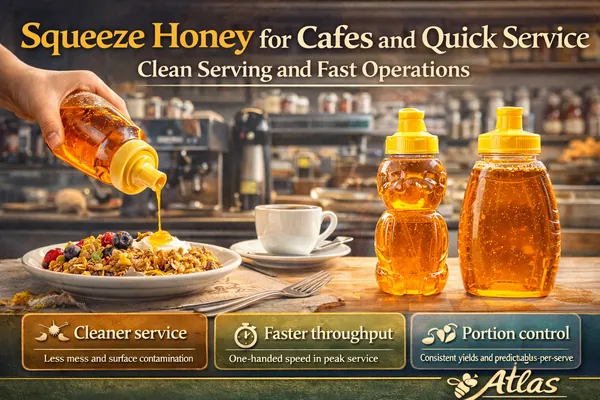
In cafes, bakeries, breakfast service, and quick-service restaurants, honey has a simple job: deliver a consistent portion quickly, without mess, without cross-contact risk, and without slowing down line staff. Open jars and shared spoons create friction—sticky countertops, inconsistent portions, and hygiene concerns. Squeeze formats solve these problems with a packaging-first approach to operational efficiency.
Less dripping, less surface contamination, fewer wipe-down cycles.
One-hand dispense supports peak-hour speed and standardized builds.
More consistent yields and more predictable cost-per-serve.
Contents
1) Why squeeze wins in high-traffic environments 2) Operational use-cases: counter, kitchen line, table service 3) Bottle and cap choices (and what to specify) 4) How to plan the right SKU set 5) Portion control and cost-per-serve 6) Quality and handling: crystallization, storage, cleaning 7) What to request from suppliers 8) Rollout checklist for operators 9) FAQ1) Why squeeze wins in high-traffic environments
Squeeze honey becomes the “default best practice” when you optimize for speed and consistency. The operational benefits are not theoretical—they show up in staff behavior, cleaning time, and portioning discipline.
- Hygiene: fewer shared utensils and less open exposure compared with jars.
- Speed: single-motion dispensing; no spooning, scraping, or lid handling.
- Consistency: easier to standardize recipes (e.g., “2 squeezes on yogurt bowl”).
- Reduced waste: less product left on spoons, lids, or rims.
- Better customer experience: cleaner presentation on plates, waffles, and drinks.
2) Operational use-cases: counter, kitchen line, table service
Before choosing bottle size and cap type, define where the product will live and who will use it. This determines the right “operator experience.”
Back-of-house / kitchen line
- Best when staff dispense repeatedly during peak hours.
- Focus on fast flow, cap reliability, and refilling or replacement speed.
- Prefer packaging that stands stable and is easy to grip with gloves.
Front counter / barista station
- Best for add-ons (oatmeal, yogurt bowls, breakfast plates) and drink builds.
- Prioritize clean tips and no-drip performance to protect equipment and counters.
Customer-facing table service
- Smaller bottles reduce table clutter and improve presentation.
- Prioritize cap closure discipline and easy wipe-clean surfaces.
3) Bottle and cap choices (and what to specify)
Many squeeze honey failures are not about honey quality—they are about packaging mismatch. Cap design affects flow rate, mess, and “clogging tolerance” if crystallization starts.
| Decision area | What it impacts | What to specify to a supplier |
|---|---|---|
| Bottle material | Squeezability, durability, transport resistance | PET/food-grade plastic preference; wall thickness expectations |
| Cap type | Flow control, mess, hygiene | Flip-top vs valve/no-drip; tip diameter preference |
| Flow rate | Portion consistency and speed | “Fast drizzle” vs “thin thread”; define use-case (waffles vs tea) |
| Label & coding | Traceability and compliance | Lot code placement on bottle and case; best-before format |
4) How to plan the right SKU set
Most cafes do not need multiple honey types in squeeze format. The goal is to cover 80–90% of use-cases with one core SKU, then add a second SKU only if it creates clear menu value or margin lift.
Practical SKU strategy
- Core SKU: everyday honey profile for broad usage (drinks, breakfast, desserts).
- Optional premium SKU: a darker or origin-led honey for signature items or upsells.
- Avoid over-complexity: multiple bottles slow training and increase inventory errors.
SKU set examples by channel
- Small cafe: 1 squeeze SKU (core), plus portion cups only if needed for delivery.
- Breakfast chain: core squeeze SKU + portion cups (controlled cost per guest).
- Premium brunch concept: core squeeze SKU + premium darker-profile honey for signature plates.
5) Portion control and cost-per-serve
In foodservice procurement, the most useful number is not “price per bottle.” It is cost per serve. Squeeze format helps standardize serve size—if you train staff and choose a cap/flow rate that supports consistency.
6) Quality and handling: crystallization, storage, cleaning
Squeeze bottles highlight issues faster than jars because tips and caps can show texture changes first. Your success depends on matching the SKU to your operating environment and rotation speed.
Crystallization and tip management
- Crystallization can occur in honey depending on composition and storage conditions. It is normal.
- Keep caps closed to reduce moisture and air exposure that can accelerate texture issues around the tip.
- If your outlet is slow-rotation, choose formats and handling routines that remain tidy over longer timeframes.
Storage rules for operations
- Store away from direct sun and heat swings (near ovens, espresso machine exhaust, or heaters).
- Maintain clean exterior surfaces; wipe tips routinely as part of station cleaning.
- Replace heavily used bottles on a schedule if presentation quality is part of your brand.
7) What to request from suppliers
A good squeeze honey program starts with a clear brief. Suppliers can respond faster and more accurately if you provide:
- Channel: cafe / QSR / hotel breakfast / catering.
- Use-case: table service, kitchen line, or counter station.
- Bottle size preference: small customer-facing vs larger back-of-house.
- Cap preference: flip-top, no-drip valve, flow rate requirements.
- Documentation: specification sheet + COA + lot coding approach.
- Destination country: for label and compliance alignment.
8) Rollout checklist for operators
Before launch
- Define serve size standard (grams or “squeeze counts”).
- Train staff on cap closure discipline and wiping tips.
- Decide which stations carry squeeze bottles (limit to avoid clutter).
- Validate storage location away from heat swings.
After launch
- Measure cost-per-serve using real usage (not theoretical).
- Monitor mess/cleanup time; adjust cap or station placement if needed.
- Audit FEFO rotation and lot handling if you run multiple locations.
9) FAQ
Why do cafes prefer squeeze honey?
Squeeze bottles support faster service, cleaner dispensing, and more consistent portion control than open jars or shared spoons, which reduces mess and improves hygiene in high-traffic environments.
What bottle size is best for cafes?
Mid-size bottles work well for staff-only stations and faster rotation, while smaller bottles can suit table service and customer-facing use. The right size depends on your daily throughput and how often you want to refill or replace bottles.
How can operators reduce clogging or tip mess?
Choose a cap that fits your use-case, keep caps closed, store away from heat swings, rotate stock quickly, and wipe tips as part of station cleaning. Most issues are solved by packaging choice and closure discipline.
Should we use portion cups instead of squeeze bottles?
Portion cups are strongest for hygiene-controlled breakfast service and cost-per-guest standardization. Squeeze bottles are strongest for speed, flexibility, and back-of-house builds. Many operators use both depending on service model.
What documents should be requested for foodservice honey?
Most professional programs request a product specification sheet, a batch-linked COA (as applicable), and clear lot coding on cases for receiving and traceability. Additional requirements depend on destination country and buyer program.