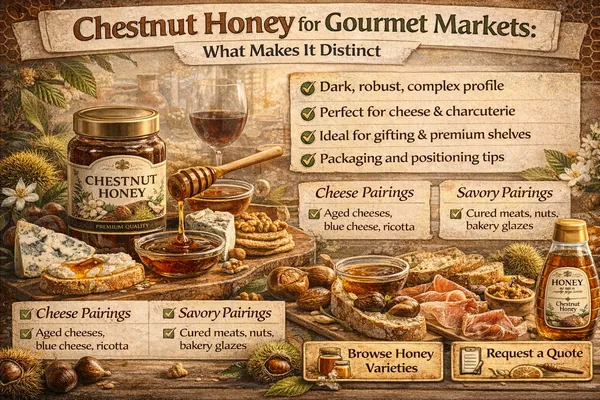
Gourmet honey buyers rarely want “another sweet honey.” They want a honey with a strong point of view—something that behaves more like a culinary ingredient than a generic sweetener. Chestnut honey is one of the most reliable SKUs for that role because it offers a bold profile that stands up to savory foods and mature cheeses.
1) What makes chestnut honey distinct?
Chestnut honey is often described as dark, robust, and aromatic, with a finish that can be perceived as tannic or pleasantly bitter. That sensory signature is a strength in gourmet retail because it creates “contrast” in the assortment.
- Color: typically dark amber to deep brown (season and region dependent).
- Aroma: woody, earthy, and intense—often more aromatic than everyday honeys.
- Taste: strong character; sweetness balanced by a deeper finish.
- Consumer perception: premium and “adult” flavor; best when the label guides usage.
2) Who buys chestnut honey, and why?
Chestnut honey performs best for shoppers who already buy premium foods. They are not looking for “mild” or “neutral.” They want a honey that pairs with cheese boards, charcuterie, bakery, and gourmet pantry staples.
| Segment | Motivation | How to win |
|---|---|---|
| Gourmet shoppers | Distinct flavors and discovery | Sensory notes + pairing cues |
| Gift buyers | Premium presentation | Smaller glass jar, elegant label, origin story |
| Cheese/charcuterie buyers | Complement savory foods | Explicit “pair with” suggestions |
| Food enthusiasts | Culinary ingredient use | Recipe-led messaging and serving ideas |
3) Positioning strategy for gourmet markets
Chestnut honey should be positioned with culinary authority. Avoid positioning it as a general “breakfast honey” unless the target market prefers strong flavors. The highest-performing positioning typically includes:
- Flavor language: robust, dark, woody, aromatic, complex finish.
- Use occasions: cheese boards, bakery, glazes, savory pairings.
- Premium cues: glass jar, clean label, origin storytelling.
4) Pairings and serving cues that drive sell-through
Pairing cues reduce consumer uncertainty. Because chestnut honey can be intense, shoppers benefit from “what to do with it” guidance.
Cheese and dairy
- Aged cheeses (hard and mature styles)
- Blue cheese (small drizzle)
- Goat cheese and ricotta
- Yogurt for “sweet + bitter” contrast
Savory and bakery
- Charcuterie boards and cured meats
- Roasted nuts and dried fruits
- Bakery glazes and dark bread
- Marinade accents (taste-led positioning)
5) Packaging formats that fit premium positioning
Packaging influences the consumer’s expectations. Chestnut honey is a premium SKU in most markets, so formats that communicate premium quality tend to perform best.
- Glass jar (primary recommendation): strongest premium cue; ideal for gourmet shelves.
- Smaller sizes: improve trial and gifting; reduce price barrier.
- PET jar (secondary option): possible for broader distribution when design still signals premium.
- Portion packs: useful for hotels, airlines, and tasting boards; supports sampling.
6) Claims-safe messaging for chestnut honey
For international markets, the safest messaging is sensory and culinary. Avoid medical or treatment claims unless explicitly permitted in your destination market.
- Sensory: “dark and robust,” “woody aroma,” “complex finish.”
- Culinary: “ideal with cheese,” “pair with charcuterie,” “glaze for bakery.”
- Guidance: “use as a finishing drizzle” or “small amount for strong flavor.”
7) Procurement notes: what to request and align internally
For premium monoflorals, procurement teams usually focus on repeatability, identity consistency, and documentation discipline. Align internally on:
- Sensory target: acceptable variation in bitterness and aroma intensity.
- Color range: define acceptable range to reduce retail surprises.
- Batch documentation: COA per lot and clear batch IDs.
- Label naming: confirm how “chestnut honey” is presented in your market.
8) RFQ template for chestnut honey
Chestnut honey quotations are fastest when the buyer defines the shelf role (premium/gourmet), packaging format, and destination requirements.