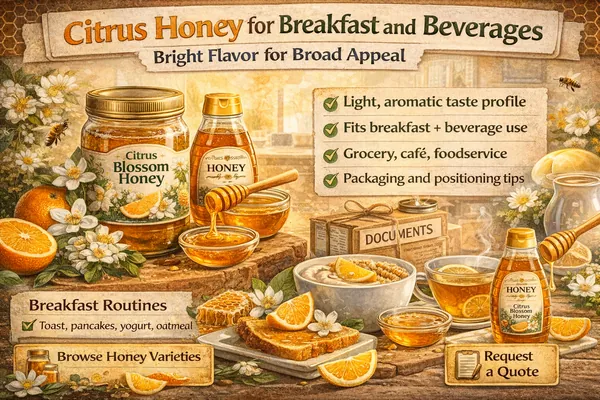
In many retail markets, honey shoppers fall into two broad groups: (1) value-first consumers who buy a familiar everyday SKU, and (2) shoppers who want a distinct taste profile they can “feel” in daily routines. Citrus honey reliably converts the second group without being polarizing.
Citrus honey is typically positioned as bright, floral, and clean. That combination works particularly well in breakfast and beverages, where consumers want sweetness plus aroma—without a heavy or smoky finish.
1) What is citrus honey, and what should buyers expect?
“Citrus honey” generally refers to honey collected during citrus blossom seasons (often orange, lemon, mandarin, or mixed citrus groves). In shelf language, brands may use “citrus blossom” or “orange blossom” if their sourcing and labeling approach supports that identity.
- Color: typically light to medium amber (market and season dependent).
- Aroma: fresh floral notes; often described as “bright.”
- Taste: clean sweetness with a lively finish; generally broad appeal.
- Texture: like other honeys, may crystallize over time depending on composition and storage.
2) Where citrus honey performs best
Citrus honey’s strongest commercial advantage is that it is easy to “place” in the consumer’s life. Buyers see better sell-through when positioning is anchored to a routine rather than a botanical explanation.
Breakfast routines
- Toast, pancakes, waffles
- Yogurt and granola bowls
- Oatmeal and cereals
- Fruit and soft cheese pairings
Beverages
- Tea (black, green, herbal)
- Warm lemon water routines (taste-led positioning)
- Café beverages (latte, chai-style drinks)
- Cold drinks (where honey dissolving guidance is provided)
3) How to structure citrus honey inside an assortment
Citrus honey can be deployed as a “step-up” SKU with a small premium over everyday blossom, or as a mid-premium monofloral depending on your shelf architecture. The key is to define its role in the lineup:
| Role | Best for | How to position |
|---|---|---|
| Bridge / Step-up SKU | Grocery shoppers upgrading from everyday honey | “Bright floral honey for breakfast and tea” |
| Monofloral story SKU | Specialty and premium shelves | Origin + harvest narrative + sensory notes |
| Foodservice flavor honey | Cafés, hotels, breakfast buffets | Portion packs / squeeze formats + routine cues |
If you already have a core blossom SKU and a darker premium SKU (e.g., pine/honeydew style), citrus honey provides variety without cannibalizing the darker profile. It also supports cross-selling with breakfast and beverage accessories (tea sets, granola, bakery).
4) Packaging formats that fit citrus honey use cases
Packaging should match the intended consumption rhythm. Citrus honey is high-frequency when positioned correctly, so formats that reduce friction often outperform “display-only” formats.
- Glass jar: premium perception; ideal for gifting and premium shelves.
- PET jar: improved export economics; value and mid-tier positioning.
- Squeeze bottle: best for family breakfast routines and repeat use.
- Portion cups / sticks: hotel, airline, café, and sampling programs.
5) Claims-safe messaging that still sells
Citrus honey sells best with sensory-led messaging and usage cues. In most markets, the lowest-risk approach is to avoid medical language and instead highlight taste, aroma, and routine.
- Sensory: “bright floral aroma,” “clean finish,” “light and refreshing sweetness.”
- Occasions: “breakfast honey,” “tea-time honey,” “café-friendly.”
- Simple directions: “1–2 teaspoons in tea,” “drizzle on yogurt,” “spread on toast.”
6) Quality and consistency notes for procurement teams
Citrus honey procurement generally focuses on repeatability and documentation. To align internally, teams often define:
- Sensory targets: color range, aroma intensity, and acceptable variation.
- Pack performance: cap sealing and leakage controls, especially for export.
- Batch documentation: COA per lot and clear batch identity.
- Label consistency: align naming (“citrus blossom” vs “orange blossom”) to your compliance approach.
7) Foodservice: where citrus honey can outperform
Foodservice buyers want consistency and convenience. Citrus honey is a strong fit because it is broadly liked and pairs with breakfast buffets and beverage programs. Consider:
- Hotel breakfast: portion cups or squeeze bottles for controlled serving.
- Cafés: sticks/sachets for tea service and take-away; clean labeling; consistent color.
- Bakery applications: for glazing and flavor accent, subject to kitchen workflows.
8) RFQ template: how to get a fast quotation for citrus honey
Citrus honey quotations move fastest when the buyer defines the shelf role and pack format. Use the template below as a procurement brief: