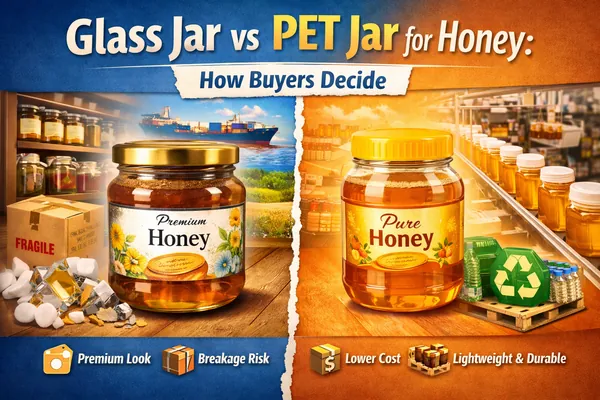
For honey buyers, packaging is not a cosmetic decision. The jar influences landed cost, shelf conversion, damage rate, warehouse handling, sustainability messaging, and the kind of customer who will pick up the product. In many tenders, the packaging format is selected before the supplier is finalized—because it drives unit economics and operational risk.
1) The buyer criteria that actually decide glass vs PET
Buyers usually evaluate jar material through six lenses. If you align on these early, quoting becomes faster and you reduce rework.
| Criteria | Glass tends to win when… | PET tends to win when… |
|---|---|---|
| Shelf positioning | You need a premium look, weight, and “giftable” feel. | You target value tiers or everyday convenience formats. |
| Landed cost | Price point can absorb higher packaging + freight. | You need the lowest delivered cost at scale. |
| Damage and returns | Secondary packaging is robust and damage rates are controlled. | Routes are long, handling is rough, or returns are expensive. |
| Channel fit | Specialty retail, premium grocery, gifting, origin storytelling. | Mass retail, e-commerce, foodservice, institutional supply. |
| Sustainability narrative | You want “infinitely recyclable” messaging and premium reuse signals. | You want lightweight transport and potentially recycled PET programs. |
| Operations | Heavier loads and careful warehousing are acceptable. | High-throughput picking, lower injury risk, easier handling. |
2) Shelf presence and buyer psychology
Packaging is a silent salesperson. In many markets, glass communicates premium because it is heavier, clearer, and associated with artisanal or origin-driven foods. PET can still look premium, but it requires more work in shape design, labeling, and closure quality.
- Glass strengths: perceived purity, clarity, premium weight, reduced scratch visibility, better “gift” perception.
- PET strengths: convenience, lighter carry, safer for families, less shatter risk, better for e-commerce.
3) Cost model: what changes in the landed-cost math
Buyers normally compare packaging cost + freight + damage rather than packaging cost alone. Glass jars usually cost more per unit and increase freight due to weight. PET is lighter, which can reduce freight and handling cost.
- Glass: higher unit packaging cost; higher freight; more protective cartons; higher damage sensitivity.
- PET: lower freight; lower breakage; often simpler secondary packaging; potentially faster warehouse operations.
In export, the weight difference matters more. In domestic supply, shelf positioning can outweigh logistics.
4) Logistics, breakage, and claims: the operational reality
Breakage and leakage claims can erase margin. Glass is inherently brittle; strong secondary packaging reduces risk but adds cost. PET is impact resistant, which often lowers claims in long-distance or multi-handling routes.
- Glass risk points: pallet impacts, corner drops, insufficient dividers, temperature shock in handling.
- PET risk points: cap/liner compatibility, deformation under high heat, label scuffing if low-quality film is used.
5) Barrier performance and product protection
Honey is generally stable, but packaging still affects appearance and long-term quality perception. Glass is an excellent barrier and is inert. PET is widely used and suitable for honey, but buyers often ask for confirmation of food-contact compliance and cap/liner compatibility.
6) Labeling, design, and how to make PET look premium
If you choose PET but want premium perception, the winning levers are design and finishing:
- Jar shape: avoid thin, generic shapes; prefer rigid walls and defined shoulders.
- Closure: use higher-quality caps, optional tamper-evident bands, and clean torque performance.
- Label material: film labels with strong adhesive; consider matte finishes and clean typography.
- Transparency control: PET can highlight bubbles or surface scuffs—quality control matters.
7) Sustainability: how buyers discuss it in tenders
Sustainability is market-specific. Some markets prefer glass due to recyclability narratives; others prefer PET due to weight and transport efficiency. The practical way to handle this is to align on the retailer or importer’s sustainability framework and local recycling realities.
- Glass narrative: recyclable, premium reuse, strong consumer acceptance in many markets.
- PET narrative: lightweight shipping, reduced breakage waste, compatibility with recycled content programs where available.
8) Which format fits which channel
| Channel | Typical buyer preference | Why |
|---|---|---|
| Premium retail / specialty | Glass | Premium shelf signal, gifting, origin story, price tolerance. |
| Mass retail / value tier | PET or mixed | Price competitiveness, lower damage risk, easier handling. |
| E-commerce | PET (often) | Lower breakage, lower returns, safer parcel handling. |
| Foodservice / hotels | PET / squeeze / portion packs | Speed, hygiene, controlled serving, lower risk. |
| Gift packs | Glass | Premium feel, presentation, better perceived value. |
9) Practical specs buyers request (send these early)
To speed up quoting and avoid revisions, buyers commonly request:
- Jar material + capacity: e.g., 250g / 400g / 500g / 1kg
- Closure type: screw cap, flip-top, tamper-evident band, liner type
- Label zone + finish: wrap-around, front/back, shrink sleeve, matte/gloss
- Carton configuration: units per carton, carton strength, dividers for glass
- Palletization: cartons per layer, layers per pallet, pallet type
- Compliance needs: destination-country requirements and language rules
10) Recommendations by buyer objective
- Maximize premium perception: choose glass, invest in label finishing, and use origin narrative.
- Win value shelves: choose PET, optimize freight and carton packing density, keep design clean.
- Reduce claims in export: PET or reinforced glass packaging with dividers and stronger cartons.
- Grow e-commerce: PET is usually safer; if glass is required, over-spec packaging and test drop scenarios.