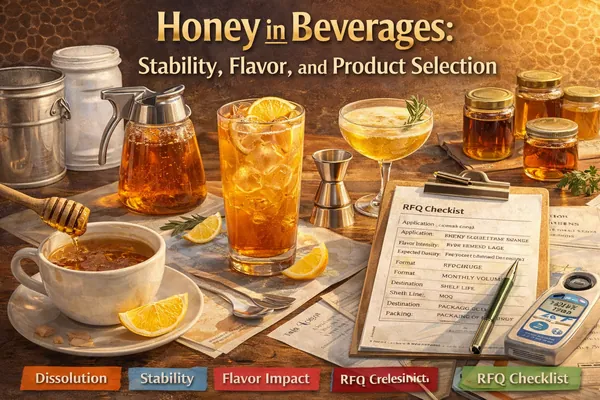
Honey can function as a sweetener, a flavor ingredient, or both. In beverages, the buying decision usually comes down to how reliably the honey performs across different drink types—hot service, cold mixing, cocktails/mocktails, and ready-to-drink production.
1) The three selection criteria that matter most
Dissolution (hot vs cold)
- Hot drinks (tea, hot lemon, lattes): dissolution is usually straightforward.
- Cold drinks (iced tea, lemonades, smoothies): honey can mix unevenly unless you standardize a method (often a syrup).
Stability (appearance and flavor consistency)
- Appearance: clouding or settling can affect perceived quality in clear drinks.
- Flavor drift: switching lots or honey types can change aroma intensity and finish.
Dosing repeatability
- Foodservice: needs quick, consistent pours across staff and shifts.
- Manufacturers: need predictable inputs, specifications, and batch documentation.
2) Practical sweetening systems (how operators keep consistency)
Option A: Direct honey addition
Works best for hot beverages and low-variability menus where honey is stirred immediately. The upside is clean labeling and simple inventory. The trade-off is slower service and higher variability in dosing.
Option B: Honey syrup (commonly used for cold drinks)
Many beverage operators use honey syrup to improve pourability, mixing, and dose control—especially for iced beverages and bar programs. Syrup also reduces “staff-to-staff” differences in sweetness.
3) Mapping honey types to beverage use-cases
| Use-case | Recommended honey role | Profile guidance | Why it works |
|---|---|---|---|
| Everyday tea & hot drinks | Base sweetener | Mild blossom / multi-flower | Broad appeal, low flavor dominance, easy to standardize |
| Iced tea, lemonades, cold mixing | Syrup system | Mild-to-medium; avoid overpowering notes | Improves dissolution, supports consistent sweetness |
| Signature drinks (menus, cafes) | Flavor + story | Distinct profiles (e.g., pine, chestnut, citrus where appropriate) | Creates differentiation and premium perception |
| Cocktails / mocktails | Flavor ingredient | Choose intentionally: floral vs resinous vs bitter notes | Honey becomes part of the flavor architecture |
| RTD / manufacturing | Ingredient input | Defined spec + consistent lots | Stability and compliance depend on specification discipline |
4) Packaging formats that support beverage operations
- Foodservice: squeeze formats and portion control packs can reduce mess and improve dosing control.
- Ingredient / production: bulk formats (pails/drums) support planned usage and handling efficiency.
- Multi-site operators: standardize one base honey for syrup and one “signature” honey for featured drinks.